Tonality measured by Distance
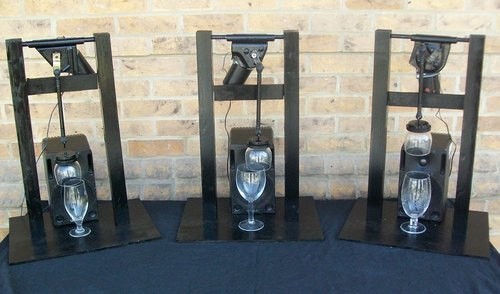
"Tonality measured by Distance" is a sound installation that explores natural resonant frequencies contained in small
spaces, as well as the way sound changes its pitch when it reflects on a surface. It
was originally inspired by the Helmholtz Resonators; the Helmholtz
Resonators where invented in the 1860's by German physicist Heinrich
Von Helmholtz. They where hollow spheres open on both ends, and where made in order to isolate and amplify the natural resonant
frequencies contained in a space. Different sizes where used in order
to isolate different frequencies.
In this piece, small tie-clip microphones are placed in glasses in front of loudspeakers. Candle-glasses are attached to windscreen wiper motors above them, rotating at a very slow speed. The candle-glasses and the glasses with the microphones inside them are acting together as one big resonator, where the feedback of the resonant frequency from the microphone to the speaker reflects. As the candle glasses are hovering above the glasses with the microphones inside them, the space in which the feedback reflects changes, affecting the pitch of the resulting tone.
Originally three resonators where constructed in order
to represent another approach to the notion of the triad as a structural basis of a chord: according to Western Classical Harmony at least three notes are necessary in order to construct a chord. Three different glasses where used, each able to produce a different tone. Each tone is tuned by sound's natural tendency to shape its form according the space it inhabits, producing a chord that results from a natural process.
The piece
however has to work with the size and demands of the space in
which it exists, so it became
an "open work" that can be adjusted to the space it is placed; the
number of the resonators used depends on the size and
acoustic qualities of the space that surrounds the work.
The soundscape produced is always changing in a random fashion; this is due to the fact that the windscreen wiper motors are moving in slightly different speeds and they are not completely synchronized. The timbre of the sound also relies on the circular motion of the candle-glasses; small pendulum movements affect the shape of the resonator and add a fluctuating effect on the frequency of the sound.
The circular and slow motion of the candle-glasses provides a strong visual equivalent to the resulting sound of the work, underlining the direct relationship of the changes in the size of the resonators and the resulting soundscape.
The materials used for this piece are everyday objects such as pint-glasses and wine glasses, in order to demonstrate the sonic qualities of these objects: the inaudible natural resonant frequencies that exist in a glass for example, and are being shaped while we are using it, changing the way they reflect inside it.
You can watch a video of the work here
|