External Shaping Factors
"... some membrane that intercedes in all our acts of communication,
an infinitesimal distance in which is eaten up a bit of each
transmission between two surfaces believed to be touching."
Loren Chase, "Ottic Diary"
"External Shaping Factors" is the final project made for my MA at Oxford Brookes University. This piece deals with the phenomenon of sonic interference, and the effects it has on sound's identity from the moment it is produced and until it reaches our perception. In ideal conditions, interference between two tones with the same amplitude and frequency can be either constructive or destructive; in the first case the sounds will reinforce each other, and in the second they will cancel each other out. Another interesting effect sonic interference can have is the creation of "beats" between tones that are closely tuned.
Every sound we hear is the result of interferences between tones of different frequencies, with different amplitude and phase. Every time we are observing a sound in nature there will always be another sound, or even inaudible vibration, affecting the form of the sound we are hearing. This project explores how a sound can change through this membrane of interference between audible and inaudible sounds.
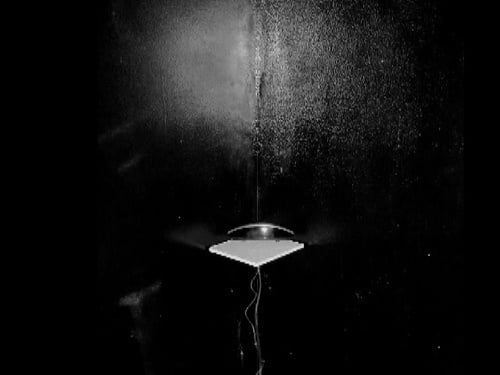
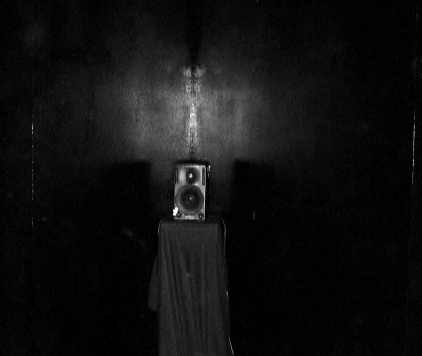
The work creates an ever-changing sonic environment, which is altered according to the position of the audience in the space. Two loudspeakers are playing recordings made around Oxford. The audience enters the room wearing wireless headphones; through the headphones, they can hear sine-tones interfering with the recordings.
The recordings are one hour long and consist of various different sonic elements such as cars, birds, the sound of the river, distant drones from airplanes and helicopters, drills and construction site noises etc. They where analyzed using Fast Furrier Transformation analysis tools in order to determine the most prominent frequencies on different instances from the recordings. The sine-tones where "tuned" in these frequencies in order to create "beats" and "blind spots" according to the audience's position in the space.
The space is completely dark; by blocking any visual stimuli, the audience is focused on sound and the effects of sonic interference become more prominent. Vision is stronger and more direct in the Western culture than hearing, and visual stimuli very often draw our attention away from sound.
Photos by Darren Toofany
|